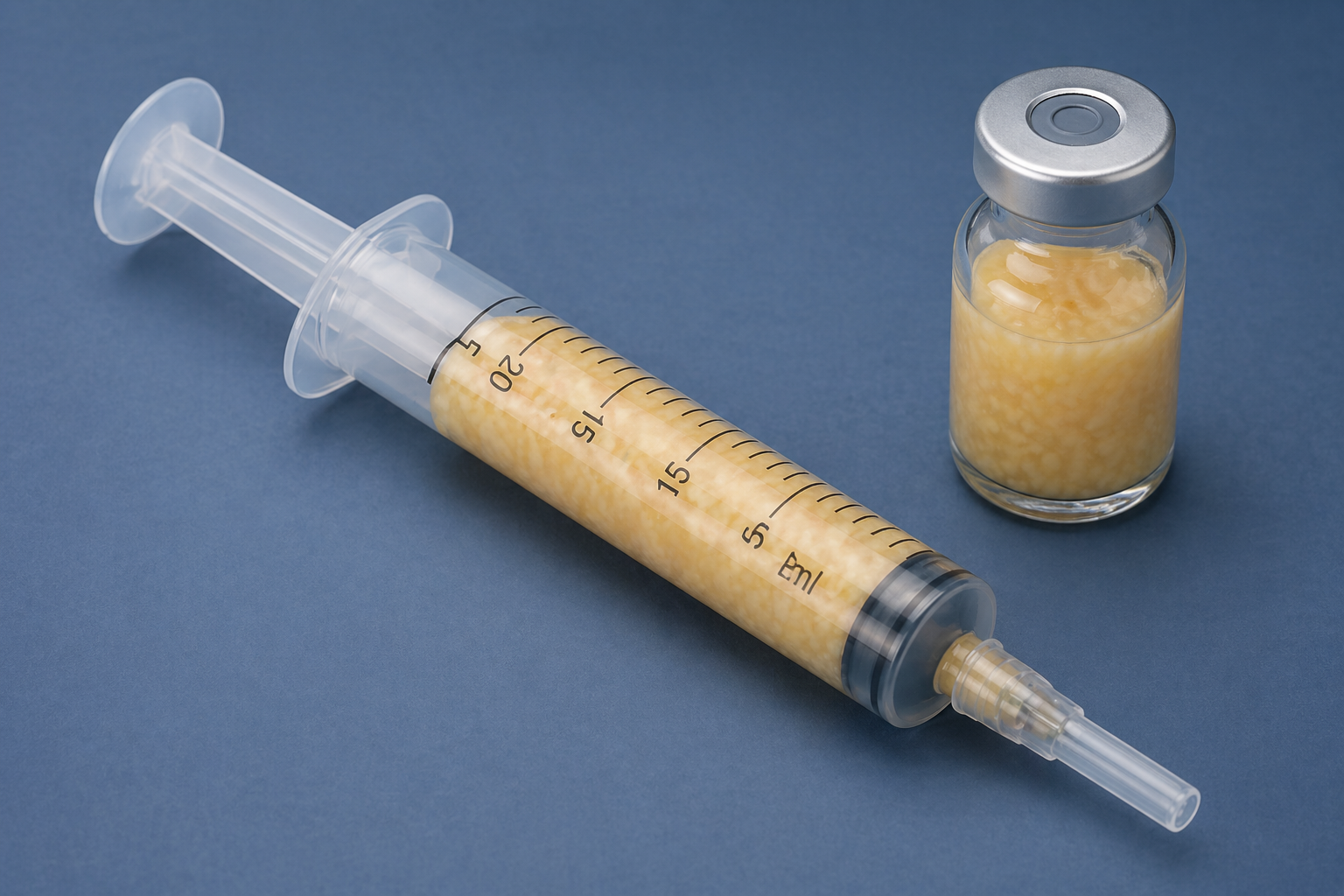
Fat Grafting for Penis Enlargement

Girth Enhancement · Semi-surgical · Autologous · Penile Fillers & Surgical

Fat Grafting
for penile girth enhancement

Autologous fat transfer uses your own body fat — harvested by liposuction from the abdomen or thighs — and injected beneath the penile skin to increase girth. It is performed by licensed physicians and uses entirely natural tissue, but carries a significant limitation: unpredictable fat retention makes results inherently variable.

Fat grafting is a legitimate medical procedure performed by qualified surgeons — but major urology and sexual medicine organizations do not endorse it as a standard or reliably effective option. This page explains why, and what men considering it need to understand before deciding.

Fat grafting penile girth enhancement
60–120 minProcedure time
Immediate then variableResults timeline
Highly variableFat retention rate
1–2 weeksTypical recovery
NoReversible

Overview

What is fat grafting for the penis?

Autologous fat transfer — commonly called fat grafting — is a two-part procedure. Fat is first harvested from another area of your body using liposuction (typically the abdomen, flanks, or inner thighs), processed to remove blood and fluid, then injected in small parcels beneath the skin of the penile shaft to add girth.

Because the material is your own tissue, there is no risk of allergic reaction and no foreign material is introduced. This makes it appealing to men who want enhancement using entirely natural, autologous material.

The fundamental challenge — and the reason this procedure generates mixed patient experiences — is that transferred fat does not reliably survive. The body reabsorbs a portion of it, and the amount that reabsorbs varies significantly and unpredictably between patients and even between areas of the same penis.

The core problem — unpredictable retention

When fat is transferred, a portion survives and integrates into the surrounding tissue. A portion does not — it is naturally reabsorbed by the body over weeks to months.

The critical problem is that nobody can predict exactly how much will survive. Published literature reports retention rates ranging from as low as 20% to as high as 80% depending on technique, patient biology, and harvest site.

When reabsorption is uneven — which is common — the result is lumpy texture, asymmetry, and irregular contour. This is the source of most of the bad patient experiences you’ve heard about, and it’s not a reflection of poor surgical skill alone. It’s an inherent limitation of the procedure.

Why it’s in two categories

Fat grafting appears under both Penile Fillers and Surgical Procedures on PhallusMD because it genuinely spans both. The fat injection into the penis is non-surgical — but the liposuction harvest is a minor surgical procedure requiring anesthesia. It’s more involved than injectable fillers but less invasive than implant surgery.

What to expect

The procedure step by step

Fat grafting is a two-phase procedure performed under local anesthesia with sedation or general anesthesia depending on the provider and the volume of fat being harvested.

01

Fat harvest by liposuction

Fat is harvested from a donor site — typically the abdomen, inner thighs, or flanks — using a small cannula and gentle suction. The harvest site requires local anesthesia and will have its own recovery period of 1–2 weeks.

This is the step that makes fat grafting more involved than injectable fillers — it is a minor surgical harvest with its own recovery.

02

Fat processing

The harvested fat is centrifuged or filtered to separate viable fat cells from blood, oil, and fluid. Only the purified fat is used for injection. Processing technique varies between providers and affects final outcomes.

03

Fat injection into the penis

The processed fat is injected in small parcels beneath the penile skin using a fine cannula, distributed evenly around the shaft to increase circumference. The penis is typically over-filled intentionally — accounting for the expected reabsorption that will follow.

Intentional overfilling to account for reabsorption is standard — but if reabsorption is less than expected, the result may be overfilled. If reabsorption is uneven, the result may be lumpy or asymmetric. This is the core unpredictability.

04

Recovery

Both the harvest site and the penis require recovery time. Most men take 1–2 weeks before returning to normal activity. Sexual activity is restricted for several weeks. Final results — once reabsorption has stabilized — are typically assessed at 3–6 months post-procedure.

The retention problem — explained clearly

Why results are unpredictable

Understanding fat retention is the most important thing any man can know before considering this procedure. Published studies report wide variation — and no current technique can guarantee a specific retention outcome.

20–80% Range of reported fat retention

The range reported in published literature. The same patient, same technique, same surgeon can produce outcomes across this spectrum depending on biology.

Uneven How reabsorption typically occurs

Fat rarely reabsorbs uniformly. Different areas of the same penis reabsorb at different rates — creating the lumpy, irregular texture that is the most common patient complaint.

3–6 mo Time until final results are visible

Final settled results aren’t visible for months. Men often seek revision surgery before the final result is even established.

Why patients report bad experiences

The pattern you hear from patients is consistent with the literature. A man gets fat grafting, the initial result looks good. Over weeks to months, fat reabsorbs — unevenly. He’s left with lumps, flatness in some areas, excess volume in others, and asymmetry. The surgery didn’t necessarily fail — the material behaved the way fat transfer behaves.

The complication isn’t rare or the result of negligence in most cases. It’s the predictable consequence of an inherently unpredictable procedure performed on a site where irregular reabsorption has significant cosmetic impact.

Risks and complications

What the medical literature reports

The following complications are documented in published urology and reconstructive surgery literature. They are not rare occurrences — they reflect the known risk profile of this procedure.

Lumps, nodules, and contour irregularities from uneven fat reabsorption

Asymmetry between sides of the shaft

Fat cyst or oil cyst formation from liquefied fat cells

Fat necrosis — dead fat tissue creating hard areas

Complete or near-complete reabsorption — losing most or all of the result

Scarring at injection or harvest sites

Infection at harvest site or injection site

Wound healing problems at the liposuction harvest site

Discomfort or pain during erection from irregular fat distribution

Need for revision surgery — commonly required

What major organizations say

Medical consensus on fat grafting for penile enhancement

The position of major professional organizations is consistent and important to understand before deciding on this procedure.

American Urological Association (AUA)

Subcutaneous fat injection not shown to be safe or effective

The AUA has stated that subcutaneous fat injection for penile girth enhancement has not been shown to be safe or effective. It is not considered a standard urological procedure and is not included in evidence-based treatment guidelines for sexual medicine.

Sexual Medicine Society of North America (SMSNA)

Graft-and-flap augmentation not recommended until better data available

SMSNA recommends against graft-and-flap penile augmentation procedures until better long-term data are available. This reflects the limited published evidence for consistent, safe, long-term outcomes from fat transfer to the penis.

What this means in practice

These positions do not mean fat grafting is categorically as dangerous as silicone or an underground procedure. It is performed by licensed, qualified surgeons in legitimate medical settings. What they mean is that the procedure lacks the consistent, long-term evidence base required for mainstream endorsement — and that men pursuing it should understand they are choosing an option that falls outside established standard care.

For men who specifically want an entirely autologous, natural-material approach and understand the retention variability, fat grafting remains a legitimate conversation to have with a qualified provider. For most men exploring girth enhancement, HA fillers or P-Thick are more predictable starting points.

How it compares

Fat grafting vs. other girth enhancement options

Feature Fat Grafting (this page) HA Fillers P-Thick™ (DermaPRP) Biostimulatory
Material Your own fat (autologous) Synthetic HA gel Your own PRP (processed) Synthetic collagen stimulant
Results predictability Low — highly variable retention High — immediate, visible Moderate Moderate — gradual
Reversible? No Yes — hyaluronidase No No
Requires surgery? Yes — liposuction harvest No — injection only No — injection only No — injection only
Recovery time 1–2 weeks (harvest site) Minimal — same day Minimal — same day Minimal — same day
Medical endorsement Not endorsed by AUA or SMSNA Widely practiced — off-label Off-label — autologous PRP Emerging — off-label
Best for Men specifically wanting autologous material who understand variability First-time patients — reversible, predictable Men wanting autologous with fewer surgical steps Men wanting subtle, longer-lasting results

Is it right for you?

Who may consider fat grafting — and who should be cautious

May be appropriate for
Men who specifically want an entirely autologous approach with no synthetic material
Men who have sufficient donor fat and are otherwise healthy candidates for liposuction
Men who have had detailed consultation with an experienced surgeon and fully understand the retention variability
Men who accept that revision may be needed and are prepared for that possibility
Men who prefer a potentially longer-lasting approach and are willing to accept unpredictable outcomes
Think carefully if you
Want predictable, immediate results — HA fillers are more appropriate
Are not prepared for the possibility of lumpy or asymmetric results requiring revision
Cannot commit to 1–2 weeks of harvest site recovery
Have not yet tried injectable filler options — they carry fewer surgical risks
Are choosing fat grafting primarily on the basis of cost — cheaper is not better here
Have been told results are guaranteed or highly predictable — they are not

Common questions

Frequently asked questions

Is fat grafting safe? +

It is performed by licensed surgeons in medical settings and uses your own tissue — so it avoids the acute risks of synthetic or unregulated materials. However, major medical organizations do not endorse it as a safe and effective standard procedure, primarily because the results are unpredictable and complications from uneven fat reabsorption are common. “Safe” relative to unregulated procedures does not mean “without significant complication risk.”

Are results permanent? +

Partially. Fat that survives the transfer and integrates into surrounding tissue may persist long-term — but a significant portion will be reabsorbed over weeks to months. Because the amount that survives is unpredictable, so is the longevity of the result. Some men retain a meaningful girth increase for years. Others lose most of it within months.

Why do so many patients report bad results? +

The bad results most commonly reported — lumps, asymmetry, irregular texture — are directly tied to uneven fat reabsorption. The initial result often looks good. Over weeks to months, fat reabsorbs in an unpredictable, non-uniform pattern, leaving areas that are fuller or flatter than others. This isn’t always a reflection of poor surgical technique — it reflects an inherent limitation of fat transfer as a material in this location. Provider selection still matters significantly.

Can fat grafting be corrected if results are bad? +

Correction is possible but complex. Lumps from fat necrosis or irregular retention can sometimes be addressed with further liposuction, excision, or fat injection to under-filled areas. However, correction surgery carries its own risks and does not guarantee an improved result. This is why choosing an experienced provider and having realistic expectations upfront is critical.

How does fat grafting compare to P-Thick (DermaPRP) for an autologous approach? +

Both use your own biological material. P-Thick uses thermally processed PRP from your blood — no liposuction required, no general anesthesia, minimal downtime. Fat grafting uses harvested fat — requiring a minor surgical harvest procedure. P-Thick has shorter duration (~9–12 months) but is a simpler, less invasive procedure. Fat grafting carries longer potential duration but at higher procedural complexity and greater unpredictability. For men who want autologous material without surgery, P-Thick is worth exploring first.

Speak with a qualified provider

Fat grafting requires an in-depth consultation with an experienced surgeon. Search our vetted provider directory — or join the forum to hear from men who have been through the procedure.

This page is for informational purposes only and does not constitute medical advice, diagnosis, or treatment recommendations. Always consult a licensed, board-certified physician before pursuing any procedure. Fat grafting for penile girth enhancement is not endorsed as a standard procedure by the AUA or SMSNA. Results vary significantly by individual — outcomes are not guaranteed. PhallusMD does not endorse specific providers or guarantee clinical outcomes.