
Suprapubic Fat Pad Removal for Penile Length: What It Is, Who It Helps, and What to Expect
This article is for informational purposes only and does not constitute medical advice. Content reflects published literature and clinical guidance as of the date of publication. Always consult a licensed physician before pursuing any treatment. Individual results vary.
For many men researching penile enhancement, the conversation focuses almost entirely on girth — fillers, grafts, implants. Length gets far less attention, partly because surgical options are limited and controversial. But there is one approach that is consistently overlooked: removing the suprapubic fat pad.
It is not a new technique. It is not experimental. And for the right man, it may be the most straightforward path to visible penile length gain without any structural modification to the penis itself.
What Is the Suprapubic Fat Pad?
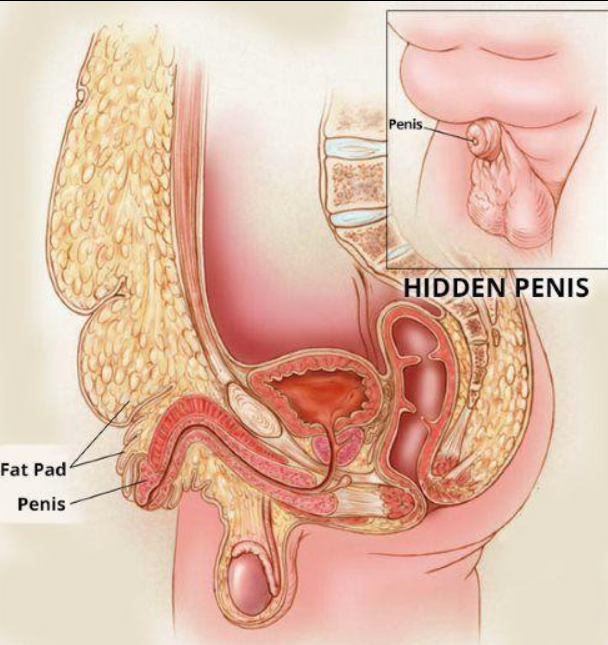
The suprapubic fat pad — sometimes called the pubic fat pad or mons pubis fat deposit — is the layer of adipose tissue that sits directly above the base of the penis, over the pubic bone. In men who carry excess weight, or who have a genetic tendency to deposit fat in this region, this pad can be substantial enough to partially bury the base of the penile shaft.
The penis itself has not shrunk. The erectile tissue is exactly the same size. But when the surrounding fat pad is prominent, it covers the base of the shaft — reducing the visible and functional length by 1–3 centimeters or more. This is sometimes called “buried penis” in its more extreme form, a recognized urological condition.
How Removal Works
Suprapubic fat pad reduction is performed through liposuction — the same technique used for body contouring anywhere else on the body. A small cannula is inserted through a tiny incision in the pubic area and fat is removed from the pad, reducing its volume and allowing more of the penile shaft to become visible.
Liposuction vs. Pubic Lift
In some cases, particularly where there is also significant skin laxity, a more extensive procedure called a pubic lift (monsplasty) may be recommended — which removes both fat and excess skin. This has a longer recovery but may produce more lasting results in men with both excess fat and loose skin in the pubic region.
Who Performs It?
Suprapubic liposuction for penile length is typically performed by plastic surgeons, cosmetic surgeons, or urologists with experience in genital and body contouring. It is not a specialty procedure in the same way that penile implant surgery is — many surgeons who perform body contouring liposuction can perform this procedure.
Who Benefits Most
Has a visible or palpable suprapubic fat pad. If pressing firmly at the base of your penis increases your apparent length significantly, there is likely a fat pad contributing to buried shaft. This is the clearest indicator.
Is at or near a stable, healthy weight. If weight fluctuates significantly after the procedure, fat may return to the area. Stable weight before the procedure helps lock in the result.
Has realistic expectations. This procedure reveals length that was already there but obscured — it does not create new structural length.
Does not have significant skin laxity. Liposuction alone works best when skin has reasonable elasticity to contract after fat removal.
How Much Length Can It Reveal?
Most men gain 1–3 cm of visible penile length after suprapubic fat removal. Some men with very substantial fat pads may see more. Importantly, this is functional length — the penis now protrudes further from the body during both flaccid and erect states.
This is different from surgical lengthening procedures like suspensory ligament release, which primarily affect flaccid length and carry more controversial outcomes.
How It Compares to Other Length Approaches
| Approach | Mechanism | AUA Position | Typical Gain |
|---|---|---|---|
| Suprapubic Fat Removal | Reveals buried shaft | No objection | 1–3cm visible |
| Suspensory Ligament Release | Releases penile anchor | Does not recommend | 1–2cm flaccid only |
| P-Long Protocol | Traction — structural gain | Supported by evidence | Variable over months |
For men with both a suprapubic fat pad and a desire for structural length gain, combining suprapubic fat removal with the P-Long Protocol makes clinical sense — fat removal reveals existing length immediately while P-Long builds additional length over time.
Recovery Timeline
- Days 3–5 Return to light activity; swelling and bruising are normal
- Weeks 2–3 Swelling and bruising largely resolve; compression garment worn
- Week 4 Compression garment typically discontinued; most men return to sexual activity (confirm with surgeon)
- Weeks 6–12 Final result visible as residual swelling fully resolves
What to Ask Your Surgeon
Your surgeon should assess this directly and explain the difference in outcomes between the two approaches.
This is a nuanced indication. You want someone who has done this specifically, not just general liposuction.
Ask to see photos from their patients with similar anatomy. Generic before/afters are not useful here.
Including contour irregularities, scarring, nerve changes in the pubic skin, and fat re-accumulation if weight changes significantly after the procedure.
Suprapubic fat pad removal is one of the most underappreciated options in men’s sexual health — not because it is secret or experimental, but because it rarely comes up in the same conversations as fillers, implants, and traction devices.
For the right man — someone with a genuine fat pad burying the base of his shaft — it is arguably the most straightforward path to visible length improvement available. No structural alteration to the penis, no AUA controversy, and recovery measured in weeks rather than months.
If pressing firmly at the base of your penis noticeably increases your apparent length, this procedure is worth a serious conversation with an experienced surgeon.